
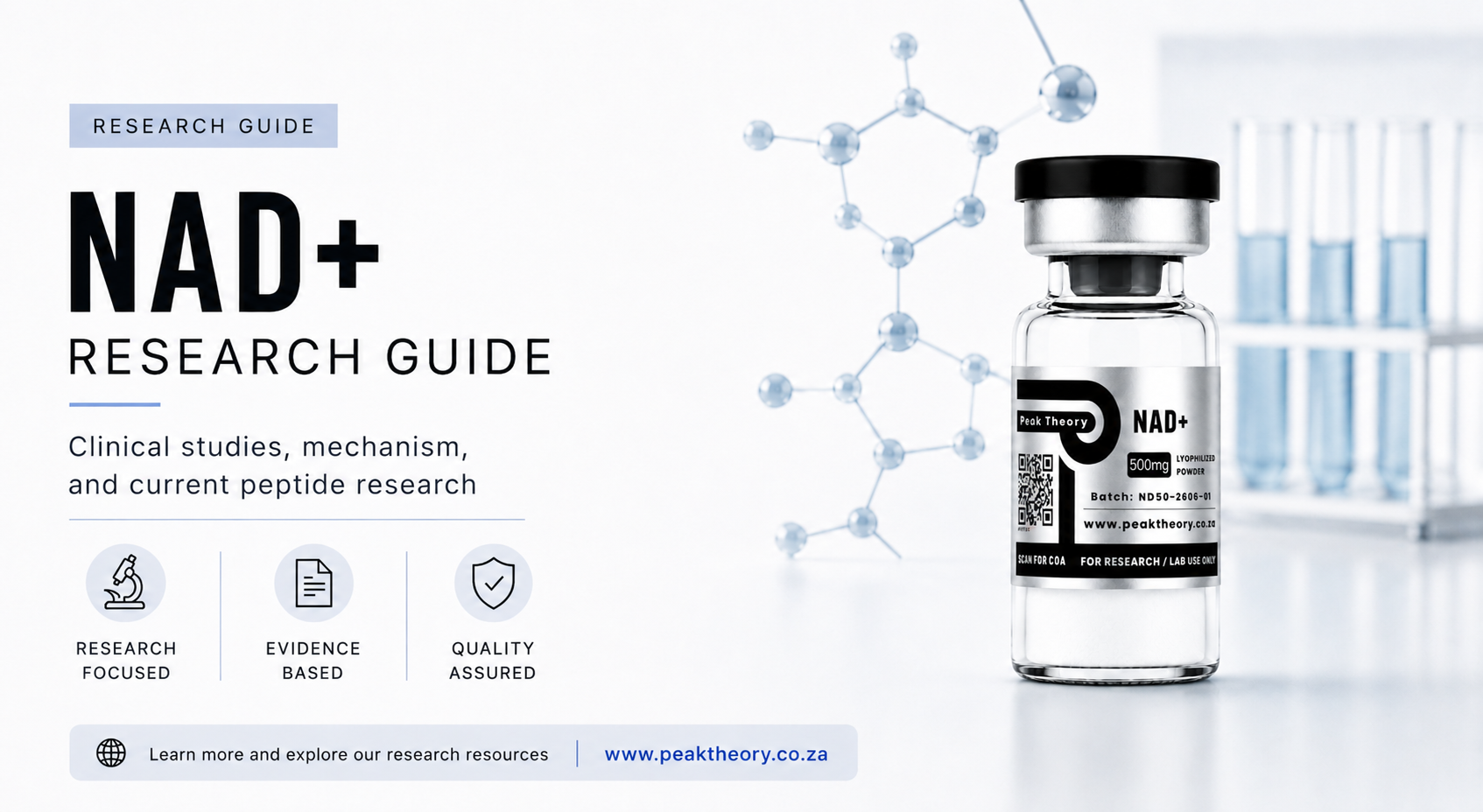
Nicotinamide adenine dinucleotide (NAD+) is a cellular cofactor involved in redox chemistry and enzyme regulation. It is a cellular cofactor rather than a peptide. NAD+ research spans metabolism, DNA-damage responses, mitochondrial biology and the pathways that synthesize, use and recycle the molecule. This guide separates established biochemistry from broader “longevity” language.
What is NAD+?
NAD+ and its reduced form, NADH, transfer electrons in reactions central to glycolysis, the tricarboxylic-acid cycle and oxidative phosphorylation. NAD+ also serves as a substrate for enzymes including sirtuins, poly(ADP-ribose) polymerases and CD38. Because these reactions compete for a shared metabolite pool, measurements depend on cell type, compartment and metabolic state.
How cells maintain NAD+ pools
Cells obtain NAD+ through several routes, including salvage of nicotinamide and pathways using nicotinic acid, nicotinamide riboside or tryptophan-derived intermediates. The contribution of each route varies across tissues and experimental conditions. Extracellular precursors may also be transformed before cellular uptake, so exposure concentration does not equal intracellular NAD+ availability.
What researchers measure
- Total NAD+, NADH and their ratio using validated enzymatic or mass-spectrometric methods.
- Expression or activity of salvage-pathway enzymes such as NAMPT and NMNAT isoforms.
- Mitochondrial respiration, ATP-linked oxygen consumption and redox-sensitive metabolites.
- PARP, sirtuin or CD38 activity alongside the specific downstream endpoint.
- Time-resolved changes across subcellular compartments where the method permits.
Studying longevity through defined endpoints
Longevity research is built from multiple defined endpoints, including metabolite dynamics, cellular resilience, genetics, immune function, tissue interactions and environmental factors. Mechanistic results generate useful hypotheses, and strong reporting names the exact endpoint so each result contributes clearly to the wider ageing-research picture.
How to read this evidence
Evidence is most informative when interpreted at the level at which it was generated. Receptor assays, cultured cells, isolated tissues, animal models and controlled clinical trials each contribute a different part of the research picture. Study duration, comparator choice, sample size, participant selection, assay conditions and sponsor involvement provide valuable context.
Researchers can strengthen interpretation by distinguishing statistical significance from biological importance, examining prespecified outcomes and matching each conclusion to the exact compound and model studied.
How the compound is studied
Published research brings together molecular, cellular and controlled-study evidence to explain how the compound interacts with biological pathways and which outcomes have been measured.
- Receptor assays examine binding, potency and intracellular signalling.
- Cell and tissue models explore pathway-specific biological responses.
- Preclinical models investigate how connected systems respond over time.
- Controlled studies measure prespecified metabolic, biochemical or body-composition outcomes where relevant.
Frequently asked research questions
How are changes in NAD+ interpreted?
NAD+ metabolism is dynamic and compartmentalized, so direction, magnitude and timing are interpreted within the relevant model.
How does precursor evidence relate to NAD+ research?
Precursor studies add valuable pathway-specific evidence because each precursor has distinct transport, metabolism and experimental exposure.
Selected primary sources
- Kulikova et al. generation and cellular handling of nicotinamide riboside (PMID 26385918)
- Cantó et al. nicotinamide riboside and NAD+ metabolism (PMID 22682224)
- Ratajczak et al. extracellular NAD+ intermediate degradation (PMID 31795381)
Related research guides
Scientific overview: This article summarises published mechanisms, study models and research findings for educational purposes.