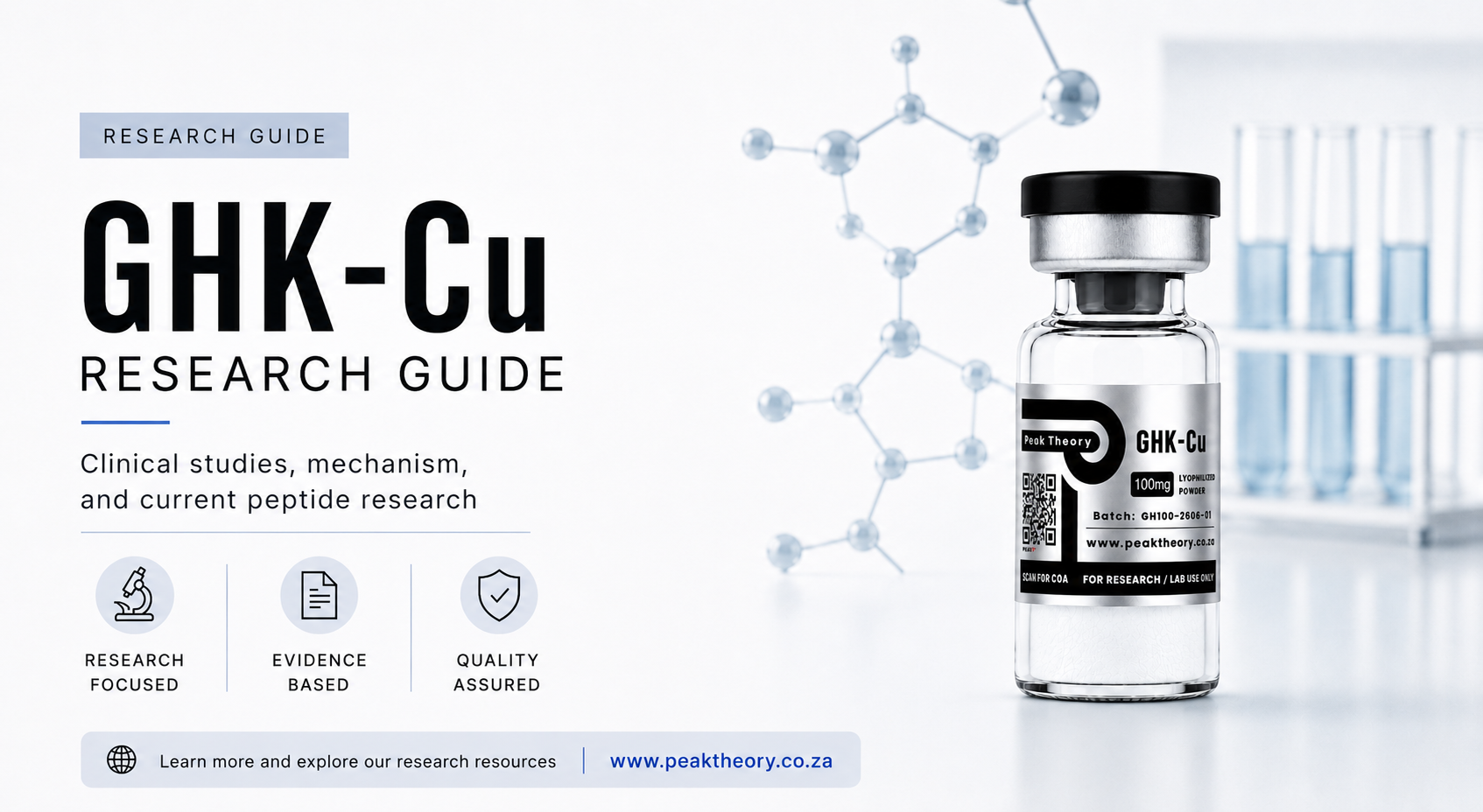
GHK-Cu is a coordination complex formed when the tripeptide glycyl-L-histidyl-L-lysine binds copper. Published research has examined its interactions with fibroblasts, extracellular-matrix regulation and tissue-repair models. This guide focuses on what those experiments measured, the limitations of the evidence and the analytical controls required for reproducible work.
Molecular identity and copper binding
GHK contains glycine, histidine and lysine. The histidine-containing structure can coordinate copper ions, producing GHK-Cu. Experimental behaviour can depend on copper occupancy, pH, competing ligands, oxidation state and medium composition. Researchers should therefore report whether they studied free GHK, a copper complex or a mixture formed under defined conditions.
Why GHK-Cu is studied
Primary studies have examined fibroblast migration, matrix metalloproteinases, collagen-associated processes and expression of growth factors in cell or wound-repair models. These endpoints provide mechanistic insight into extracellular-matrix turnover and cellular signalling and help guide progressively more complex research models.
Useful experimental controls
- A vehicle control and untreated control.
- Free GHK and an appropriate copper control when the research question concerns complex-specific effects.
- A positive control linked to the chosen endpoint.
- Cell-viability and cytotoxicity measurements to separate signalling from nonspecific stress.
- Use independent experimental repeats and multiple time points to assess reproducibility.
Common interpretation errors
It is incorrect to treat collagen staining, gene expression and functional tissue repair as interchangeable outcomes. It is also incorrect to transfer a result from a defined GHK-Cu preparation to a proprietary blend without confirming composition and conducting blend-specific testing.
How to read this evidence
Evidence is most informative when interpreted at the level at which it was generated. Receptor assays, cultured cells, isolated tissues, animal models and controlled clinical trials each contribute a different part of the research picture. Study duration, comparator choice, sample size, participant selection, assay conditions and sponsor involvement provide valuable context.
Researchers can strengthen interpretation by distinguishing statistical significance from biological importance, examining prespecified outcomes and matching each conclusion to the exact compound and model studied.
How the compound is studied
Published research brings together molecular, cellular and controlled-study evidence to explain how the compound interacts with biological pathways and which outcomes have been measured.
- Receptor assays examine binding, potency and intracellular signalling.
- Cell and tissue models explore pathway-specific biological responses.
- Preclinical models investigate how connected systems respond over time.
- Controlled studies measure prespecified metabolic, biochemical or body-composition outcomes where relevant.
Frequently asked research questions
How does GHK-Cu differ from elemental copper?
GHK-Cu is a ligand–metal complex whose properties reflect coordination chemistry and the experimental conditions.
What should a reproducible methods section report?
At minimum: copper-to-peptide basis, preparation solvent, pH, experimental model, exposure duration, controls, assay readouts and statistical plan.
Selected primary sources
- Siméon et al. fibroblast MMP-2 research (PMID 11045606)
- Pollard et al. growth-factor expression research (PMID 15655171)
- Maquart et al. tripeptide-copper tissue-repair model (PMID 8836453)
Related research guides
Scientific overview: This article summarises published mechanisms, study models and research findings for educational purposes.